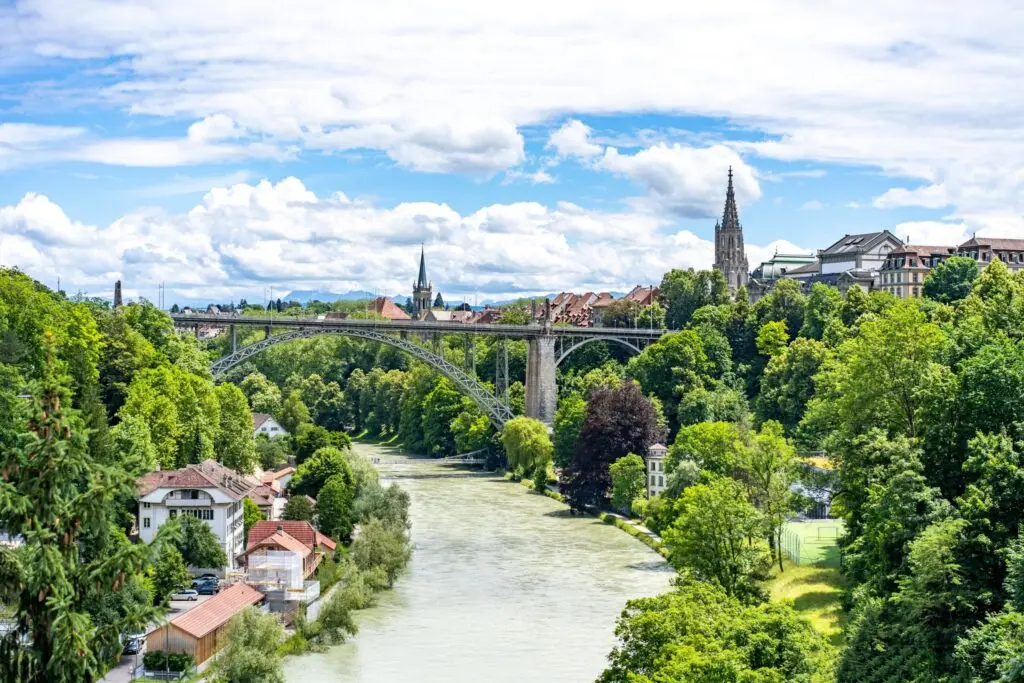
Bern is the seat of the Swiss government and one of the least self-important capitals in Europe. The old town sits inside a loop of the river Aare, has barely changed shape since the Middle Ages, and is on the UNESCO World Heritage list. It is also small enough to walk end to end in half an hour, which is why a day here works better than you would expect.
Here are the landmarks worth your time, and a sensible order to take them in.
The Zytglogge
The clock tower in the middle of the old town started life as a city gate in the thirteenth century, and became a clock tower when Bern outgrew its walls. The astronomical clock on the eastern face dates from the sixteenth century and still runs on its original mechanism: a rooster crows, a jester rings bells and a procession of bears turns, starting a few minutes before every hour.
Stand on the eastern side, arrive early, and do not expect a spectacle, it is small, mechanical and quietly extraordinary once you know it has been doing this for roughly five hundred years. Guided tours of the mechanism inside are worth booking if you like machines.
The Bern Minster
The late Gothic cathedral has the tallest church spire in Switzerland at just over 100 metres, and it took more than four centuries to finish, begun in 1421, completed in 1893. The main portal has an unusually complete Last Judgement carving that survived the Reformation because it was on the outside.
Climb the tower. It is 344 steps, the staircase is tight, and the view covers the whole loop of the river, the roofs of the old town and, on a clear day, the Bernese Alps on the horizon.
The arcades and the fountains
Bern's old town has around six kilometres of covered arcades, one of the longest sheltered shopping runs anywhere. Practically, it means you can walk the entire centre in heavy rain without getting wet, which in Switzerland is not a minor feature.
Set into the streets are the sixteenth-century fountains, each with a painted figure on top. The strangest by a distance is the Kindlifresserbrunnen, the child eater: an ogre stuffing an infant into his mouth with more in a sack. Nobody agrees on what it means. The explanations range from a warning to children to a carnival figure, and the honest answer is that the original intention is lost.
Einstein's house
At Kramgasse 49, in the middle of the arcades, is the flat where Albert Einstein lived while working as a clerk at the Swiss patent office. He wrote the papers of 1905 here, special relativity among them, in his spare time, in a small second-floor apartment that is now a museum furnished as it would have been.
It takes twenty minutes and it is the most quietly impressive room in the city: an ordinary flat above a shopping street where the physics of the twentieth century got rewritten.
The Aare
The river loops around three sides of the old town, and in summer it is the centre of Bern life. People walk upstream to Eichholz or the Marzili baths, get in, and float back down to the city with the current. The Marzili lido is free and sits directly below the parliament building; politicians swim there.
The important part: the Aare is cold, fast and serious. Get in and out at the marked exits, know where you are getting out before you get in, and do not attempt it if you are not a strong swimmer. People drown here most years. Watch first, ask a local, then decide.
The Federal Palace
The Bundeshaus, where the Swiss parliament sits, is open for free guided tours when parliament is not in session, and you can watch debates from the gallery when it is. The square in front has 26 water jets, one for each canton, that shoot straight out of the paving; in summer children run through them and nobody stops them.
A note that surprises people: Switzerland has no formal capital city. Bern is the federal city, the seat of government, which is a deliberate constitutional distinction rather than a technicality.
Bears, roses and Klee
The BearPark
Bern is named after bears and has kept them since the sixteenth century. The old pit was replaced in 2009 by an open enclosure running down the riverbank, which is a considerable improvement on what came before.
The Rose Garden
Up the hill on the far bank, a park with hundreds of rose varieties and the best view of the old town: the whole loop of the river with the Minster spire in the middle. Free, and the best photograph in Bern.
Zentrum Paul Klee
On the eastern edge of the city, Renzo Piano's building of three steel waves holds the largest collection of Paul Klee's work anywhere. Klee grew up in Bern. Worth the tram ride if you have half a day.
Seeing it as a route
Everything above except the Klee centre lies on a single line through the old town, which makes Bern unusually easy to do on foot. A city game turns that line into a route with something to solve at each stop, so the fountains and the arcades become things you look at properly rather than walk past.
Frequently asked questions
How long do I need in Bern?
One full day covers the old town, the Minster tower, Einstein's house and the Rose Garden. Two days let you add the Paul Klee centre, the Kunstmuseum and a swim in the Aare.
Is Bern expensive?
Yes, like the rest of Switzerland. The savings are in the free things, and there are many: the arcades, the fountains, the Rose Garden, the Marzili lido, the parliament tours and the river itself.
What language is spoken?
German, in the Bernese dialect, which even other German speakers find slow and distinctive. French, Italian and English are all widely understood in the centre.
When should I visit?
May to September for the river and the long evenings. November has the Zibelemärit, the onion market, an enormous early-morning market with confetti and onion tarts that is one of the odder things in Swiss public life.
Is the Aare really safe to swim?
For strong swimmers who know the exit points and follow local advice, it is a normal summer activity. For everyone else, it is not. Take it seriously; the current is much faster than it looks.
Does Bern work for a group?
Well. The old town is compact and flat, the arcades keep a group together in bad weather, and everything is within walking distance. For organised group activities, see what we run for companies and groups.
Plan the day
A good shape: the Zytglogge and the arcades in the morning, the Minster tower before lunch, Einstein's house afterwards, the Rose Garden in the late afternoon and the river in the evening if it is warm. If you want the morning to have a route, here is how our games work, and you can get in touch about running one. Staying in Switzerland? Our guide to fun things to do in Geneva covers the other end of the country.