Where to start
Munich is Bavaria's capital and behaves like it: wealthier, more conservative and more self-satisfied than Berlin, with better food and much better parks. The centre is small enough to walk, the museums are genuinely world class, and the drinking culture is not a cliché invented for visitors.
Start at Marienplatz. The neo-Gothic new town hall looks medieval and is nineteenth century; its Glockenspiel performs at fixed times each day, with jousting knights and dancing coopers. It is slow and slightly silly and everyone watches it once. Then look at the Frauenkirche, whose twin domed towers still define the skyline, because Munich voted to keep new buildings in the centre below them.
The Englischer Garten and the surfers
Munich's central park is enormous, larger than Central Park in New York, and it runs for kilometres along the Isar. What makes it unmissable is at the southern edge: the Eisbach, a fast artificial channel that produces a standing wave where surfers queue on the bank and take turns riding it. They do this all year, including in snow. It is free to watch and completely absorbing.
Further in, the Chinesischer Turm beer garden serves under the trees. The rule in a Bavarian beer garden is that you may bring your own food and buy the drinks, which is why locals arrive with a bag of bread and cheese.
Museums: the ones that are worth the time
The Pinakothek der Moderne covers modern art, design, graphics and architecture in one building, which makes it unusually good value for a single visit. Next door, the Alte Pinakothek holds old masters and the Neue Pinakothek the nineteenth century.
The Deutsches Museum on its island in the Isar is one of the largest science and technology museums in the world, with mining tunnels, aircraft and machines you can operate. Allow far more time than you think.
And the BMW Museum, next to the four-cylinder tower and the BMW Welt showroom at Olympiapark, is worth it even if cars bore you, because it is really a design museum. Combine it with the 1972 Olympic park and its sweeping tent roof.
The Siegestor and the honest inscription
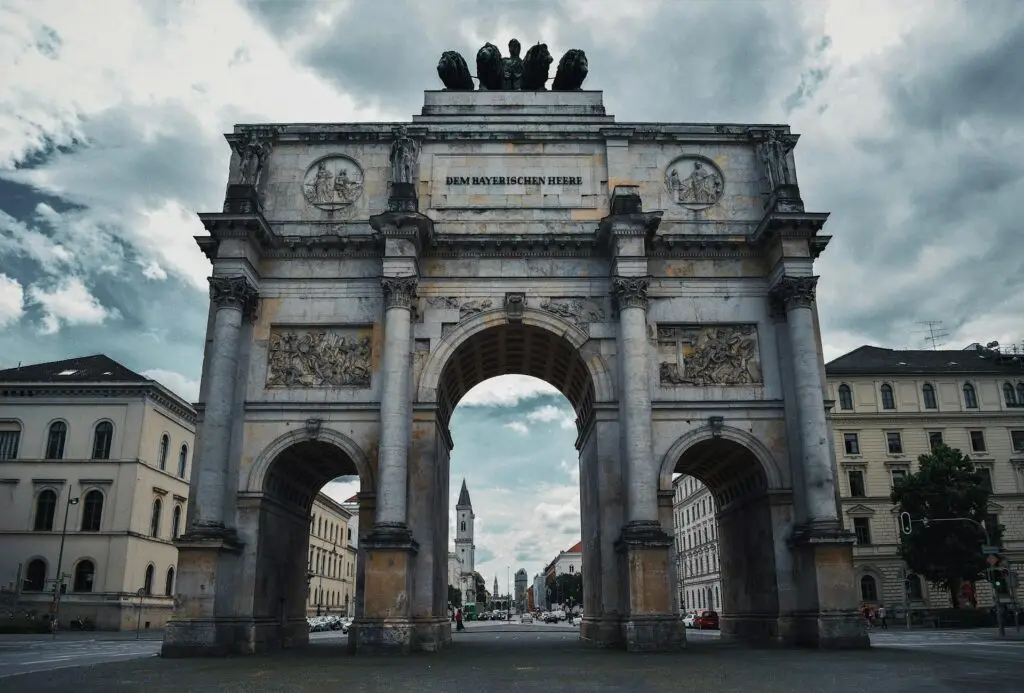
On Ludwigstraße, the Siegestor is a triumphal arch built to celebrate the Bavarian army. It was badly damaged in the war and rebuilt only partly, and the inscription added on the back says, in effect, that it was dedicated to victory, destroyed by war, and now urges peace. It is the most quietly devastating monument in the city, and most visitors walk straight past it.
Neuschwanstein: the correction
Neuschwanstein is not in Munich. The castle sits near Füssen, roughly two hours away by train and bus, and the trip is a full day rather than an afternoon. It is worth doing, but book the timed entry ticket well ahead, expect crowds, and know that the castle was never finished and never really lived in. If your time is short, Munich itself and the Nymphenburg Palace on the city edge will serve you better.
Eating, drinking and the Oktoberfest question
Eat at the Viktualienmarkt: cheese, fish, roast pork, and a beer garden in the middle whose beer rotates between the city breweries. Order Weisswurst before noon with sweet mustard and a pretzel, and do not eat the skin.
Oktoberfest runs from mid-September into early October on the Theresienwiese. It is enormous, free to enter and impossible to get a tent table at without a reservation made months earlier. If you are coming outside those weeks, a normal beer garden gives you the same thing without the scale.
Seeing Munich by playing it
The old centre is dense with things you will miss at walking speed: the devil's footprint story in the Frauenkirche, the gates of the vanished city wall, the small courtyards off the shopping streets. A city game gives you a route and clues that make you look, which is a much better use of a morning than the pedestrian shopping street. It works with families, friends and work groups.
Frequently asked questions
How many days do I need in Munich?
Two days for the centre, a park and one or two museums. Three if you want a day trip to a castle or the mountains.
Is Neuschwanstein a day trip from Munich?
Yes, but a full one: around two hours each way, and timed tickets that need booking in advance.
When is Oktoberfest?
Mid-September to the first weekend of October. Book accommodation months ahead, because prices rise steeply.
Is Munich expensive?
It is one of Germany's most expensive cities for accommodation. Food, museums and transport are reasonable, and the parks are free.
Do I need a car?
No. The U-Bahn and S-Bahn cover everything here, including the airport and Olympiapark.
Come and play in Munich
If you want to see the city rather than queue in it, walk it with a playing route. Here is how it works, and for team outings and larger groups we have formats on this page. Questions about dates, group sizes or routes? Get in touch. An hour and a half north, and much older: Regensburg.